|
- Metadata-Version: 2.4
- Name: requests
- Version: 2.32.4
- Summary: Python HTTP for Humans.
- Home-page: https://requests.readthedocs.io
- Author: Kenneth Reitz
- Author-email: me@kennethreitz.org
- License: Apache-2.0
- Project-URL: Documentation, https://requests.readthedocs.io
- Project-URL: Source, https://github.com/psf/requests
- Classifier: Development Status :: 5 - Production/Stable
- Classifier: Environment :: Web Environment
- Classifier: Intended Audience :: Developers
- Classifier: License :: OSI Approved :: Apache Software License
- Classifier: Natural Language :: English
- Classifier: Operating System :: OS Independent
- Classifier: Programming Language :: Python
- Classifier: Programming Language :: Python :: 3
- Classifier: Programming Language :: Python :: 3.8
- Classifier: Programming Language :: Python :: 3.9
- Classifier: Programming Language :: Python :: 3.10
- Classifier: Programming Language :: Python :: 3.11
- Classifier: Programming Language :: Python :: 3.12
- Classifier: Programming Language :: Python :: 3.13
- Classifier: Programming Language :: Python :: 3 :: Only
- Classifier: Programming Language :: Python :: Implementation :: CPython
- Classifier: Programming Language :: Python :: Implementation :: PyPy
- Classifier: Topic :: Internet :: WWW/HTTP
- Classifier: Topic :: Software Development :: Libraries
- Requires-Python: >=3.8
- Description-Content-Type: text/markdown
- License-File: LICENSE
- Requires-Dist: charset_normalizer<4,>=2
- Requires-Dist: idna<4,>=2.5
- Requires-Dist: urllib3<3,>=1.21.1
- Requires-Dist: certifi>=2017.4.17
- Provides-Extra: security
- Provides-Extra: socks
- Requires-Dist: PySocks!=1.5.7,>=1.5.6; extra == "socks"
- Provides-Extra: use-chardet-on-py3
- Requires-Dist: chardet<6,>=3.0.2; extra == "use-chardet-on-py3"
- Dynamic: author
- Dynamic: author-email
- Dynamic: classifier
- Dynamic: description
- Dynamic: description-content-type
- Dynamic: home-page
- Dynamic: license
- Dynamic: license-file
- Dynamic: project-url
- Dynamic: provides-extra
- Dynamic: requires-dist
- Dynamic: requires-python
- Dynamic: summary
-
- # Requests
-
- **Requests** is a simple, yet elegant, HTTP library.
-
- ```python
- >>> import requests
- >>> r = requests.get('https://httpbin.org/basic-auth/user/pass', auth=('user', 'pass'))
- >>> r.status_code
- 200
- >>> r.headers['content-type']
- 'application/json; charset=utf8'
- >>> r.encoding
- 'utf-8'
- >>> r.text
- '{"authenticated": true, ...'
- >>> r.json()
- {'authenticated': True, ...}
- ```
-
- Requests allows you to send HTTP/1.1 requests extremely easily. There’s no need to manually add query strings to your URLs, or to form-encode your `PUT` & `POST` data — but nowadays, just use the `json` method!
-
- Requests is one of the most downloaded Python packages today, pulling in around `30M downloads / week`— according to GitHub, Requests is currently [depended upon](https://github.com/psf/requests/network/dependents?package_id=UGFja2FnZS01NzA4OTExNg%3D%3D) by `1,000,000+` repositories. You may certainly put your trust in this code.
-
- [](https://pepy.tech/project/requests)
- [](https://pypi.org/project/requests)
- [](https://github.com/psf/requests/graphs/contributors)
-
- ## Installing Requests and Supported Versions
-
- Requests is available on PyPI:
-
- ```console
- $ python -m pip install requests
- ```
-
- Requests officially supports Python 3.8+.
-
- ## Supported Features & Best–Practices
-
- Requests is ready for the demands of building robust and reliable HTTP–speaking applications, for the needs of today.
-
- - Keep-Alive & Connection Pooling
- - International Domains and URLs
- - Sessions with Cookie Persistence
- - Browser-style TLS/SSL Verification
- - Basic & Digest Authentication
- - Familiar `dict`–like Cookies
- - Automatic Content Decompression and Decoding
- - Multi-part File Uploads
- - SOCKS Proxy Support
- - Connection Timeouts
- - Streaming Downloads
- - Automatic honoring of `.netrc`
- - Chunked HTTP Requests
-
- ## API Reference and User Guide available on [Read the Docs](https://requests.readthedocs.io)
-
- [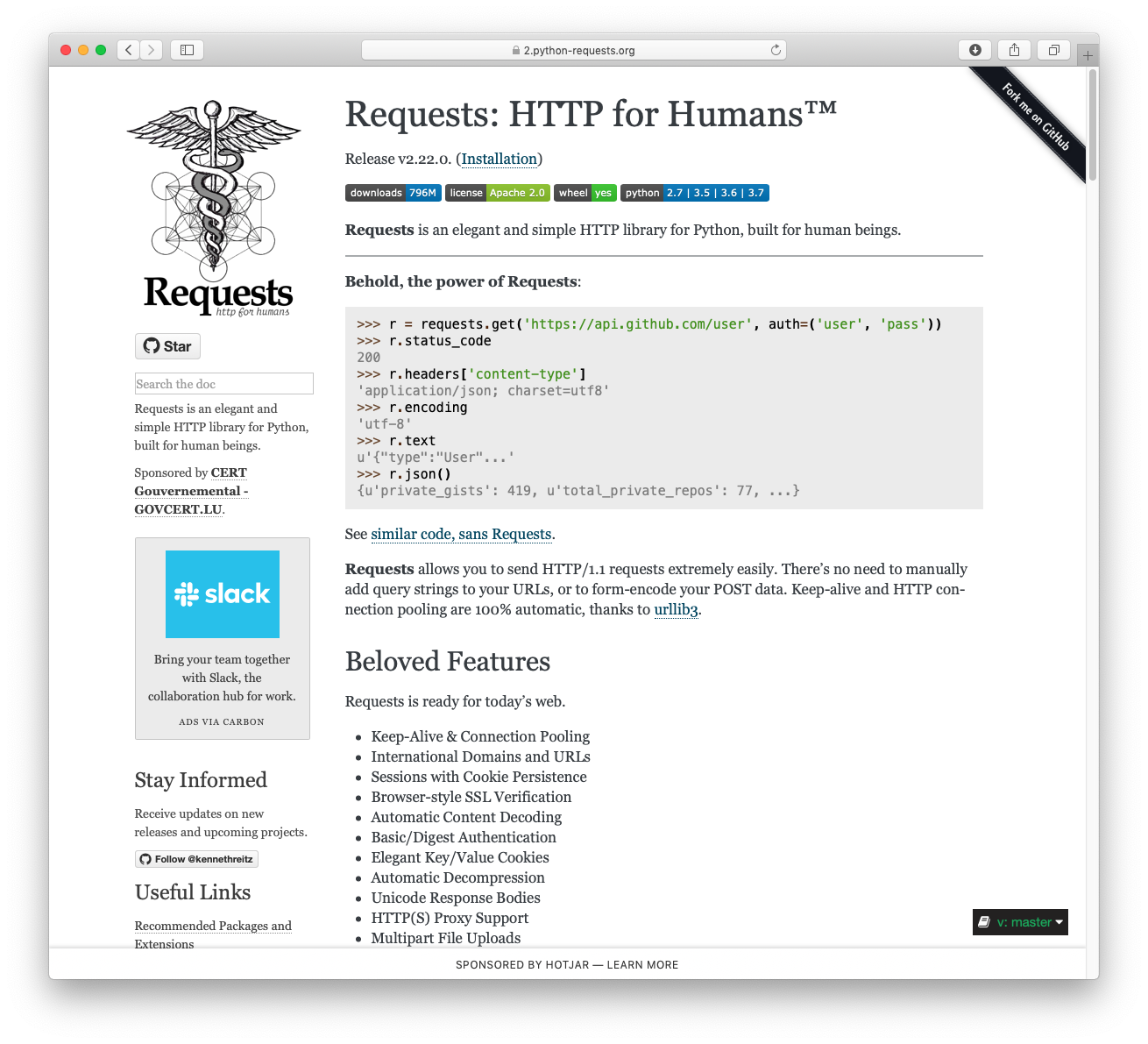](https://requests.readthedocs.io)
-
- ## Cloning the repository
-
- When cloning the Requests repository, you may need to add the `-c
- fetch.fsck.badTimezone=ignore` flag to avoid an error about a bad commit (see
- [this issue](https://github.com/psf/requests/issues/2690) for more background):
-
- ```shell
- git clone -c fetch.fsck.badTimezone=ignore https://github.com/psf/requests.git
- ```
-
- You can also apply this setting to your global Git config:
-
- ```shell
- git config --global fetch.fsck.badTimezone ignore
- ```
-
- ---
-
- [](https://kennethreitz.org) [](https://www.python.org/psf)
|
